
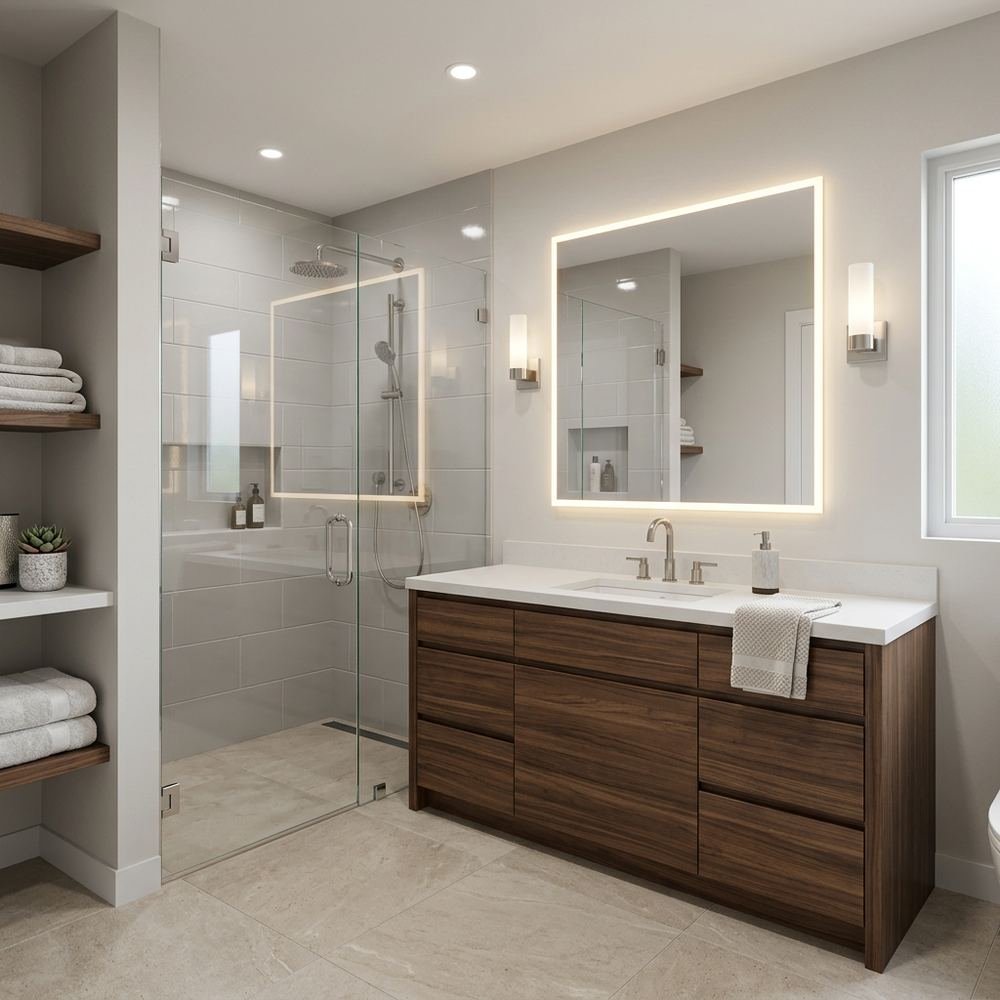
Bathroom Materials and Fittings That Survive Daily Use
Bathrooms fail in predictable places: grout, the vanity base, and whatever the water in your area does to the fittings.
Bathroom failures in Pakistani homes concentrate in a few places: grout that discolours, vanity bases that swell, tap finishes that pit under hard water, and silicone seals that go black. Choosing materials with those specific failures in mind matters more than choosing by appearance, because everything looks good in a showroom and only some of it looks good in five years.
Which tiles work best?
For floors, tiles need enough slip resistance to be safe when wet. A polished tile that looks excellent dry becomes genuinely dangerous with water on it, and a bathroom floor is wet daily.
Porcelain generally outperforms ceramic for floors because it is denser and absorbs less water, which matters in a room that stays humid. Ceramic is fine on walls, where it takes no foot traffic.
Larger tiles mean fewer grout lines, which is both a cleaning advantage and a visual one, since fewer interruptions make a small room read larger. The limit is the floor fall, because a floor sloping to a drain needs the tile size to work with that slope rather than fight it. Very large tiles on a strongly falling floor create problems.
Natural stone is beautiful and needs sealing and maintenance in a wet room. It is a commitment rather than a fit and forget choice.
Why does grout always look bad after a few years?
Because standard cement grout is porous. It absorbs water, soap residue and whatever is in your water supply, and it sits slightly below the tile face where dirt collects.
Three things help.
- A darker or mid tone grout shows discolouration far less than white, particularly on floors.
- Epoxy grout is non porous and resists staining substantially better. It costs more and is harder to apply, so it needs a tiler who has used it before.
- Narrower joints mean less grout exposed, though this requires tiles with consistent edges.
Grout at internal corners and at the junction between floor and wall should be flexible sealant rather than rigid grout, because those junctions move slightly and rigid grout cracks there. Cracked grout at a corner is a water path.
What should you know about hard water?
Water hardness varies considerably across Pakistan, and it determines how long fittings look new.
Hard water leaves mineral deposits on taps, shower heads and glass. On chrome this shows as spotting that returns quickly after cleaning. On glass shower panels it builds a film that becomes permanent if left.
Practical responses: choose tap finishes that hide spotting better than polished chrome does, wipe glass after use or accept the maintenance, and consider whether shower heads can be descaled easily since blocked outlets are usually mineral rather than mechanical.
If your area has notably hard water, factor that into the finish decision rather than choosing purely on looks.
Which vanity materials survive?
The vanity takes more moisture than anything else in the room and it fails from the bottom up.
Marine grade plywood is the sensible carcass choice, for the same reason it is used under a kitchen sink: it tolerates repeated damp without delaminating. Fibre boards can be used for fronts that stay sealed and away from standing water, but they swell irreversibly once an edge is exposed.
Three details decide longevity regardless of board:
- Heavy edge banding, because thin banding lifts in humidity and exposes the core.
- Sealed cut edges around plumbing penetrations. The cutout in the back panel for the waste pipe is the most commonly unsealed edge in any vanity.
- Keeping the base clear of the wet floor, either by mounting the unit on the wall or by using a recessed plinth in a water tolerant material.
What about the countertop?
The same logic as a kitchen worktop, with different priorities. Heat is not a factor, but standing water and cosmetics are.
Engineered quartz is non porous and handles cosmetics, toothpaste and cleaning products without staining, which makes it a strong bathroom choice. Granite works well and benefits from sealing. Marble looks beautiful and is vulnerable to the acidic contents of many bathroom products, so it needs care.
Whatever the material, the junction between the counter and the wall needs a proper seal, because that is where water sits after every use.
Which fittings are worth spending on?
The ones used most and the ones hardest to replace.
Taps and mixers are operated several times a day, and the cartridge inside determines whether they still work smoothly in years to come. This is where cheap fittings show first.
Concealed items deserve particular attention, because replacing anything built into a wall means opening tiling. A concealed cistern or a built in shower valve should be a considered purchase rather than a saving.
Waste and drainage fittings are invisible and cause disproportionate trouble when they fail.
Conversely, visible accessories such as towel rails and holders can be changed easily at any time, so they are a reasonable place to economise.
Why does silicone go black?
Because mould grows in it where it stays damp, typically around the bath, shower tray and basin junctions.
Better ventilation is the real fix, since mould needs sustained moisture. Wiping down surfaces after showering helps considerably.
Silicone is a consumable rather than a permanent material. Expect to replace it periodically, and treat blackening as maintenance rather than as a failure of the bathroom.
What is worth insisting on?
- Waterproofing beneath the floor and turned up the walls.
- Falls that actually drain, checked with water before tiling.
- Ventilation, without which a bathroom will grow mould however well it is finished.
- Flexible sealant rather than rigid grout at all internal corners.
- Access to concealed valves and cisterns for future servicing.
Having it built
Grains builds bathroom vanities and complete bathrooms with units specified for a wet room rather than carried over from bedroom joinery, manufactured at our own facility on Raiwind Road and installed by our own teams. We measure the room, plan the drainage and storage, and show you the design in 3D at no charge. Message WhatsApp +92 320 4443864, or see the range on our services page.
Questions, answered.
Porcelain generally outperforms ceramic on floors because it is denser and absorbs less water, which matters in a room that stays humid. Slip resistance matters more than appearance, since a polished tile that looks excellent dry becomes genuinely dangerous wet, and bathroom floors are wet daily.
Standard cement grout is porous and sits below the tile face where dirt collects. Choose a darker or mid tone grout, consider epoxy grout which is non porous and resists staining far better, and use narrower joints. At internal corners use flexible sealant rather than rigid grout, which cracks there.
It leaves mineral deposits on taps, shower heads and glass. On polished chrome it shows as spotting that returns quickly after cleaning, and on glass it builds a film that becomes permanent if left. Choose finishes that hide spotting, and check that shower heads can be descaled easily.
Marine grade plywood for the carcass, because it tolerates repeated damp without delaminating. Fibre boards can work for fronts kept sealed and away from standing water. Regardless of board, heavy edge banding, sealed cut edges around plumbing, and keeping the base off the wet floor decide how long it lasts.
Taps and mixers, since they are used several times a day and the internal cartridge determines whether they stay smooth. And anything concealed, such as a built in cistern or shower valve, because replacing those means opening tiling. Towel rails and visible accessories can be changed easily, so economise there.
Mould grows in it wherever it stays damp, typically around the bath, shower tray and basin. Better ventilation is the real fix since mould needs sustained moisture, and wiping surfaces after showering helps. Treat silicone as a consumable to be replaced periodically rather than as a permanent material.
Planning this for your own home?
We measure your space in Lahore free of charge, show you a 3D design before anything is cut, then manufacture and install it with our own teams.